A Curious Find in the Knockmealdowns
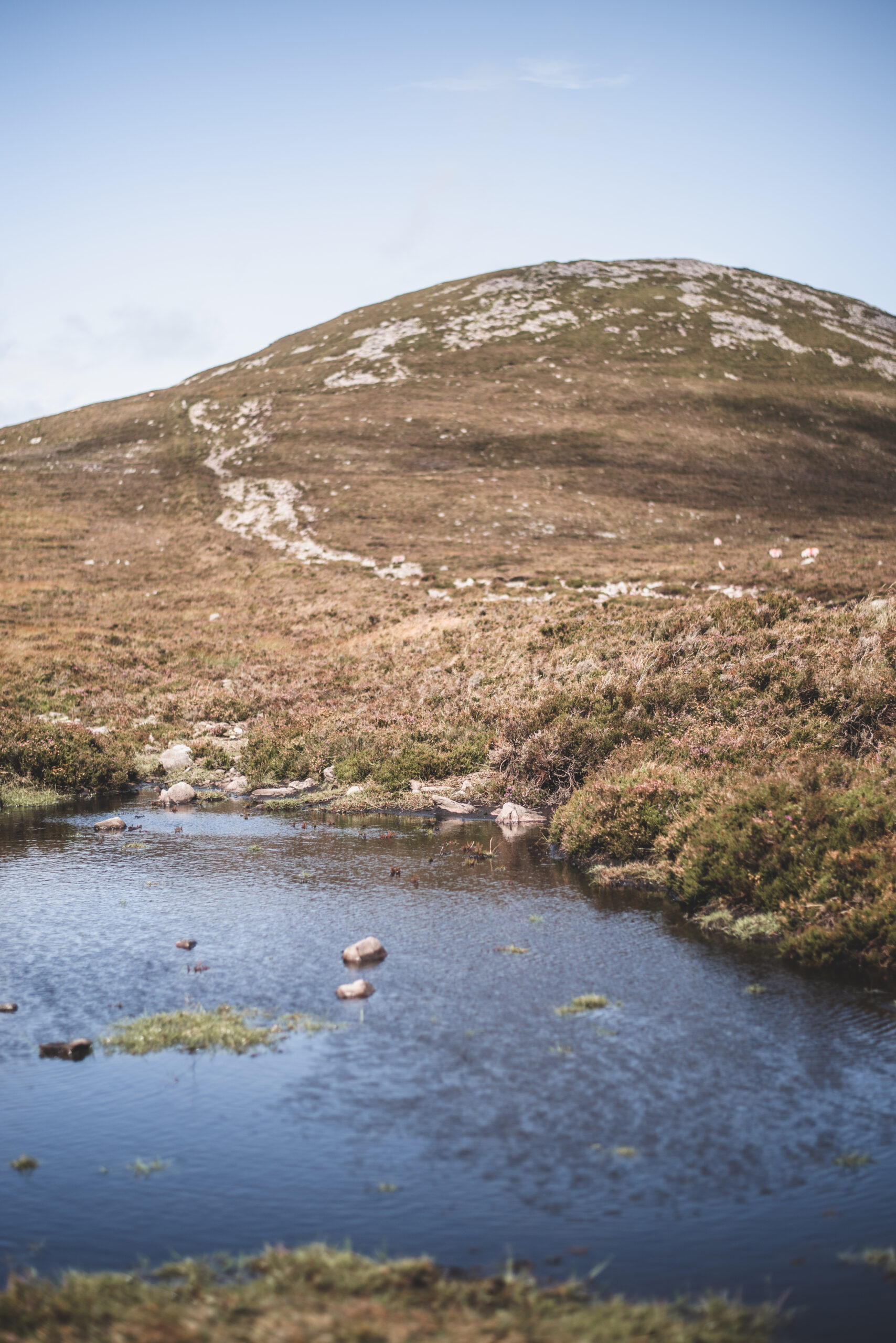
The Knockmealdown Mountains straddle the border between Waterford and Tipperary, their ridges offering sweeping views over valleys and plains. Like most Irish ranges, they’re not just places of beauty – they’re landscapes steeped in history, legend, and the occasional mystery.
While poring over an EastWest map of the range, I noticed two graves marked high on the hills. These turned out to belong to two very different men: Samuel Grubb and Henry Eeles.
One grave is tied to a well-known local family. The other is wrapped in eccentric stories of science, invention, and folklore.
Samuel Grubb: The Upright Burial
Samuel Grubb (1855–1921) was a Quaker mill owner from Clogheen, County Tipperary. Before his death, he made an unusual request: he wanted to be buried standing upright in the Knockmealdowns, with his face toward the Golden Vale.
Why? Grubb’s reasoning was that he wanted to spend eternity “looking out” over the Vale – a fertile stretch of farmland that was central to life in Tipperary and to his family’s business. His grave sits high above the countryside, a lasting symbol of connection to the land below.
The Eccentric Henry Eeles
The second grave is far less straightforward. Attributed to Henry Eeles (sometimes spelled Eccles or Eeeles), it belongs to a man who lived in nearby Lismore in the 18th century.
Eeles was a philosopher, scientist, and gentleman known for his experiments with electricity and meteorology. In 1771, he published Letters from Lismore, where he claimed lightning and electricity were one and the same — a bold idea at the time. He also contributed to the Philosophical Transactions of the Royal Society, though he never quite got the recognition he craved.
But beyond science, he was remembered for his wild streak and eccentricity. He built mechanical contraptions, held unconventional religious views, and entertained (or terrified) his neighbours with bizarre inventions.
The Sailing Chariot
One of his most famous creations was a sailing chariot – essentially a wheeled boat rigged with sails that he could steer across open ground.
According to accounts, Eeles once brought this contraption to the beach at Youghal, carrying several gentlemen along for a ride. As they cruised comfortably along the strand, he suddenly veered off-course and plunged straight into the sea. His passengers were horrified, convinced they were about to drown.
To their shock (and eventual amusement), the chariot was watertight. It bobbed along the waves and sailed as smoothly on water as it had on land. The incident cemented Eeles’ reputation as both a genius and a madman in equal measure.
Burial on the Mountain
Eeles’ last wish was as eccentric as his life: he wanted to be buried on the summit of Knockmealdown Mountain.
From there, the stories diverge:
- Some accounts say he was buried upright with his dog and gun, prepared for eternal hunting.
- Others claim he asked to be buried in a barrel of rum, with ammunition for one last day of sport when he rose again.
- A more sober version has him interred in a plain wooden coffin, carried to the mountain top by eight men, each paid for their effort.
Rumours even claim an iron rod was driven through his body to attract lightning after death, or that Tipperary men returned later to dig up his grave and steal his gun.
The exact truth? Lost to time. But the folklore has proven more enduring than any plain oak coffin.
Conflicting Historical Sources
Different publications over the years add their own details:
- The Hibernian Magazine (1781) records the death of “Henry Eeles Esq.” of Lismore, praising his scientific writings.
- The Reliquary (1864) insists he was buried with his dog and gun.
- The Illustrated Guide to the Blackwater and Ardmore (1898) repeats the story.
- The Journal of the Cork Historical & Archaeological Society (1904) adds anecdotes of his scientific experiments, sailing chariot, and his eccentric burial wishes.
- The Dungarvan Observer (1939) disputes parts of the tale, quoting relatives who denied the presence of horse or dog in his grave.
Each account shares the same backbone — eccentric philosopher, bold experiments, mountain burial – but the embellishments differ, making it hard to separate fact from folklore.
Why These Graves Matter
Together, Grubb and Eeles left a lasting mark on the Knockmealdown Mountains. One represents a family’s deep ties to the land, the other a man whose eccentricity and imagination live on through story.
For hikers, stumbling upon these graves is a reminder that the hills hold more than trails and scenery. They’re places of memory, myth, and human quirkiness, where history and folklore blend with the landscape itself.
Visiting the Knockmealdown Graves Today
If you’d like to see these sites:
- Use an EastWest Map – while Samuel Grubb’s grave is very well marked and often visited, Henry Eeles is much more difficult to find.
- Remember these are burial places; visit with respect. Grubb’s grave has unfortunately been subjected to graffiti in the past.
- Be prepared for rapidly changing mountain weather.
The Knockmealdowns offer excellent hiking, and the graves add an unexpected layer of mystery and story to the experience.
Wrapping Up
Two men, two very different lives, one mountain. Samuel Grubb, the Quaker mill owner buried upright to watch over the Golden Vale. And Henry Eeles, the eccentric philosopher whose inventions, experiments, and wild burial requests blurred the line between genius and folklore.
Fact or fiction, their stories live on in the Knockmealdowns – proof that Ireland’s mountains don’t just hold beauty, but history and imagination too.
Happy hiking agus slán go fóill.
📚 Sources & Further Reading
- EastWest Mapping – The Mystery of Major Eeles
- The Hibernian Magazine, or, compendium of entertaining knowledge (1781), james potts, December edition, p. 672
- The Reliquary (1864), Vol. 4, “The Annals of Lismore,” p. 156
- The Illustrated Guide to the Blackwater and Ardmore (1898), W. G. Field, p. 26
- Journal of the Cork Historical & Archaeological Society (1904), Vol. X, Second Series, p. 119
- The Dungarvan Observer (1939), Dec 9 issue, p. 5



Leave a Reply